Edit 2024-12-08: Do not use boltsniper’s optimal barrel length formula. It is inaccurate. I am continually surprised by the people who seem to skim read this post and don’t realize that I’m arguing against using boltsniper’s formula.
Whenever there is a thread about one of the holy grails of Nerf ballistics, an equation for the barrel length that maximizes performance, someone is bound to mention the results of some tests boltsniper did in 2005 when he was designing the FAR. boltsniper, for the uninitiated, is one of the few engineers in the Nerf hobby, so his words have some authority behind them. People generally misrepresent what he said and overstate this formula’s abilities. What boltsniper actually said is written below. The emphasis is mine.
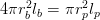
I did some experimentation to determine what would be the optimal barrel length for a given plunger size. The goal was to find the barrel length for which the dart would exit the barrel as the plunger reaches the end of the plunger tube. I started off by matching the volume of the plunger to the volume of the barrel. I knew that this was going to produce too long a barrel but it was a good place to start. This would assume that the air inside the plunger and barrel is incompressible and that there are no leaks. In the real world this is not the case. I reduced the barrel length until I had found the length at which the dart was leaving the barrel as the plunger was reaching its stop, coinciding with the maximum attainable range. Experimentally the plunger volume seems to be about 4 times that of the barrel. The relation for barrel to plunger size can be summed up in the following equation,
where
is the barrel radius,
is the plunger radius,
is the barrel length, and
is the plunger length. For Nerf applications the barrel is almost always 1/2″ PVC or CPVC.Â
This simple equation makes it easy to roughly but quickly size a barrel to a given plunger. The equation could also be used to size a plunger for a given length barrel. This equation is based on experimental data and is not perfect. Four is not the golden number. This produces the optimal barrel length for the situation I was testing. The type of dart, dart-barrel friction, and total system volume will likely effect the optimal ratio. Nevertheless, the above equation can be used as a starting point.

The last paragraph seems to be completely ignored by most people who use this formula. At best it’s a starting point for further testing. The equation only applies to the FAR as that was all that he tested.
boltsniper later expanded on the restrictions on the use of this formula at NerfHaven. (Again, the emphasis is my own.)
I derived that empirically and more importantly it was derived for the specific situation I intended on using it for: a plunger weapon. It will not work for a compressed air system. One of the big factors I used to come up with that was the lack of compressibility. I later factored that in with a constant that was derived empirically. My tests were with a setup exactly like I was going to use on a the finished product. If you scale the system down that magic constant may not hold true.
There are too many variables to analytically design the optimal barrel length. If you are going to build or mod a spring gun the equation I provided may be a good starting point. That equation gives a barrel length that is slightly too long, so to obtain the optimal length you are going to have to go shorter.
The only real way to do it is experimentally.
The short message is that this equation only applies for the situation he was testing for.
But does it even apply for that situation? I’d argue no. boltsniper wasn’t testing for optimal barrel length. In his own words (which I emphasized above), boltsniper’s “goal was to find the barrel length for which the dart would exit the barrel as the plunger reaches the end of the plunger tube.” This does not coincide with when performance peaks based on my understanding of the interior ballistic processes.
Performance is maximized when acceleration slows to zero. If the plunger is at the end of the plunger tube, the pressure is approximately maximized. This corresponds to maximum acceleration because the force is maximized, not maximum velocity. The ideal barrel length is definitely longer in this case.
(I’ll mostly ignore the question of how he knew the plunger struck the end of the tube when the dart left. I seriously question how he determined that. The entire process occurs in a fraction of a second. He’d need a high speed camera with a clear plunger tube and barrel, some other optimal system, some acoustic system, some similar combination, or something I’m not considering to actually determine this with accuracy.)
In summary, this formula should not be used for general purpose design to approximate ideal barrel length. I suggest using a chronometer, ballistic pendulum, or some other device or procedure to measure the muzzle velocity or where it stops increasing as the barrel length is changed. Alternatively, range can be measured, but please note that drag can cause range to not increase from increases in muzzle velocity, the performance parameter that we’re examining.
If more general-purpose approximations are wanted, I have developed approximate equations for ideal barrel length of pneumatics and springers based on adiabatic process relationships. These equations apply when the pressure in the barrel approximately equals the pressure in the gas chamber or plunger tube. For pneumatics, this is valid for very fast and high speed valves and very heavy projectiles. For springers, this is valid for very heavy projectiles. How heavy “very heavy” is depends on the situation, and I have not fully developed a criteria to determine this. The link contains an approximation I developed a year ago.
 is).
is).

 directly, we can find that the maximum velocity of a Nerf dart in the y direction is less than 10 m/s. But Nerf darts almost always will be traveling faster than 30 m/s. If we assume that
  we commit at worst a 5% error if the x velocity stays above 30 m/s. This is the assumption I will make.
 could be made;
  , the y velocity neglecting drag, might be good for a conservative approximation. We could assume that
  or another variable (like the height, or range), perhaps even a multiple of it. The multiple case reduces to an extra factor the drag coefficient (already a fudge factor for our purposes) can absorb. I will not take any of these approaches as I am only exploring potentially valid solutions now.


 to get the complete solution.
 .
.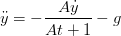

 where the subscript represents differentiation with respect to that variable. The general solution for this ODE is
 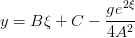 .
. (the dart does not start with any vertical velocity as it is fired flat) and
  where h is the height of the barrel I arrive at the following equation for the dart’s y position as a function of time.
 and substitute back into the ODE to check. You can also check the ICs; they are satisfied. Additionally, the solution approaches the solution without drag. At first I thought it did not, but it can be shown to approach this solution exactly with Taylor series expansion.
 (and the equivalent for y) to avoid time all together, but this approach has another problem: what
  and develop some approximations for different scenarios.
 probably will save us and allow an explicit equation for the range to be formed.
  . Note that this allows us to replace the ln term in the y equation with a multiple of x. x = R (the range) when the dart hits the ground… this may allow us to find the time the dart hits the ground as a function of R, which we can substitute back into the x equation to solve (hopefully) for R. That is the outline of what I will attempt now.
 , where
  .
.
 where
where  is the unexpanded inner diameter of the tube and
  is the unexpanded tube wall thickness, was accurate.
 is the outer diameter of the tube.
  refers to the expanded state. A variable or constant without
  is the equation for the cross sectional area of the unexpanded tube.
![A^e = \tfrac{\pi}{4} [(D_o^e)^2-(D_i^e)^2]](http://btrettel.nerfers.com/wp-content/latex/909/909be35771d66b437b608f0c88395eca-ffffff-000000-0.png "A^e = \tfrac{\pi}{4} [(D_o^e)^2-(D_i^e)^2]") is the equation for the cross sectional area of the expanded tube.
is the equation for the cross sectional area of the expanded tube. is my assumption about when the tubes stop expanding.
 , where
  is my assumption about the cross sectional areas of the tubes when they stop expanding.
 , I find that
  .
. = 7.35 and
 = 0.9999, which would definitely be lower if there were more data points). These constants seem reasonable given my understanding of the phenomena, so it is reasonable to accept that the tubes’ inner diameters expand to about 7.35 times their original inner diameter and the cross sectional area increases by 3.33 times.
 can find the expanded wall thickness.
![D_i^e = (C_1 D_i)^{-1} [\sqrt{4(t C_2)^2 (D_i + t)^2 + (C_1 D_i)^2 (D_o^e)^2} - 2 t C_2 (D_i + t)]](http://btrettel.nerfers.com/wp-content/latex/3db/3db2081ce5e683bdf4bfe9f16bddbd22-ffffff-000000-0.png "D_i^e = (C_1 D_i)^{-1} [\sqrt{4(t C_2)^2 (D_i + t)^2 + (C_1 D_i)^2 (D_o^e)^2} - 2 t C_2 (D_i + t)]")